

Fully Managed vs. Co-Managed IT: Which Is Better for a 30–40 Employee Healthcare Practice in Phoenix?
A practical guide to fully managed vs. co-managed IT pricing, service responsibilities, HIPAA security considerations, and choosing the right support model for a growing Phoenix medical practice.
For a 30–40 employee healthcare practice in Phoenix, fully managed IT typically costs $150–$250 per billable user per month through COEUS, while co-managed IT ranges from $105–$205 per billable user per month. At 35 billable users, that equals $5,250–$8,750 monthly for fully managed IT or $3,675–$7,175 for co-managed IT. The better choice depends on three factors: the practice’s internal IT capabilities, the responsibilities assigned to its provider, and its cybersecurity and HIPAA security needs. COEUS offers co-managed arrangements with or without internal IT staff, depending on the agreed scope.
A healthcare practice cannot choose the right IT service model based on monthly price alone.
Electronic health records (EHRs), scheduling, billing, patient communications, and security systems all require reliable support. Practices also need clear responsibility for access management, backups, incident response, and security documentation.
Fully managed and co-managed IT can both support these needs, but the division of work is different.
COEUS provides managed and co-managed IT services and healthcare IT and security services in Arizona. The appropriate arrangement depends on the organization’s systems, staffing, operational requirements, and agreed service boundaries.
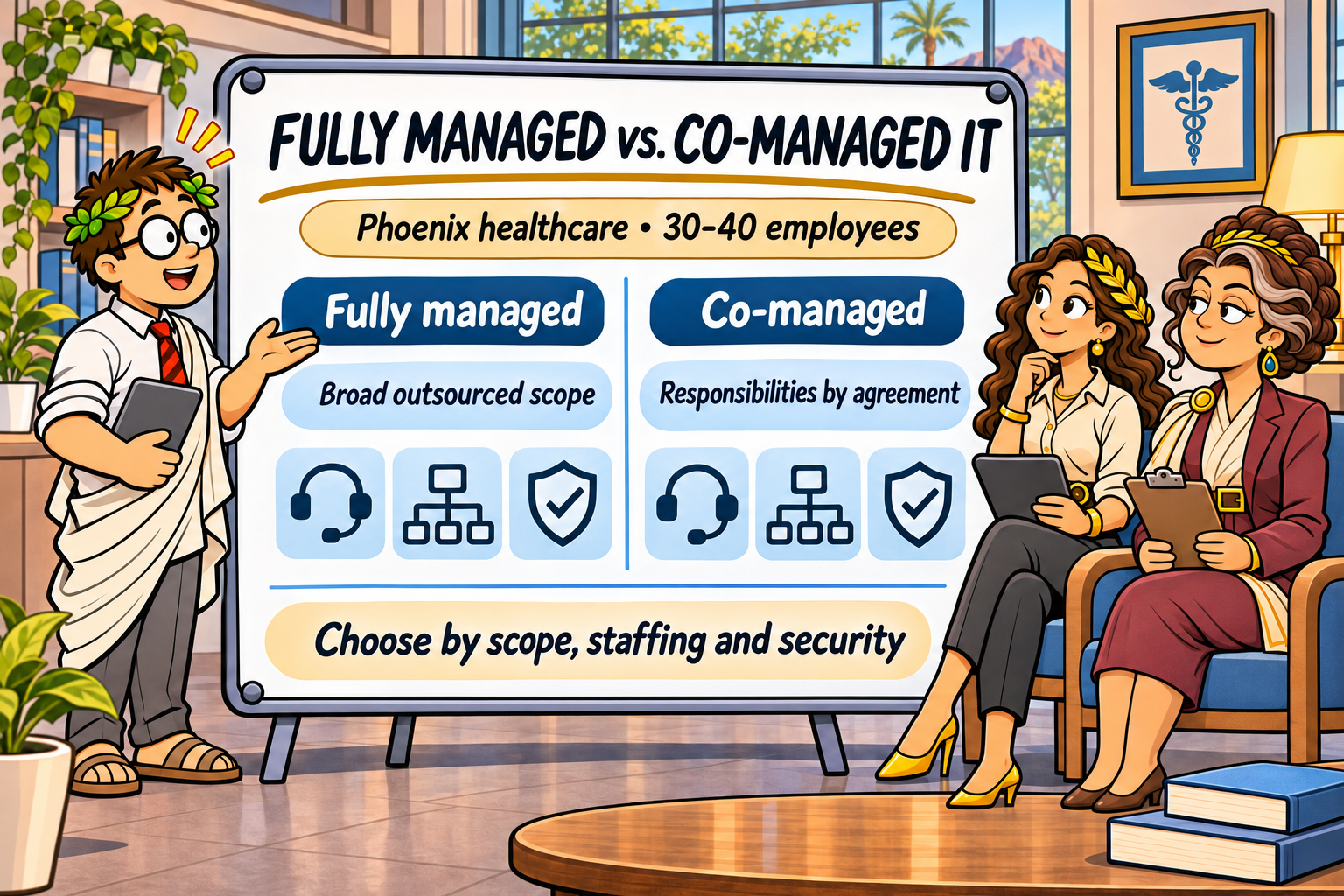
1. What Is the Difference Between Fully Managed and Co-Managed IT?
The primary difference is how IT responsibilities are allocated, not simply whether the practice has an internal IT employee.
Fully Managed IT
In a fully managed arrangement, the external provider generally takes primary responsibility for an agreed set of day-to-day IT services.
Depending on the contract, these may include:
- Help desk and end-user support
- Endpoint management and maintenance
- Network and infrastructure support
- Security monitoring and related tools
- Backup management
- Vendor coordination
- IT planning and reporting
The practice still retains responsibility for business decisions, internal policies, appropriate workforce conduct, and applicable regulatory obligations.
Co-Managed IT
Co-managed IT distributes responsibilities according to an agreed service model.
In some organizations, an internal IT employee handles everyday user requests while the MSP provides advanced cybersecurity, infrastructure management, or specialized expertise.
In others, the organization has no dedicated IT employee but chooses a more narrowly defined or shared-responsibility service arrangement.
COEUS offers co-managed IT with or without internal IT staff, depending on the scope. The label should not be interpreted as a promise that every service is included.
Compare the Two Models
| Decision factor | Fully Managed IT | Co-Managed IT |
|---|---|---|
| Primary approach | Provider handles a broad, agreed IT service scope | Responsibilities are allocated by agreement |
| Internal IT staff required? | No | Not necessarily with COEUS |
| Help desk | Typically included within agreed coverage | Depends on scope |
| Cybersecurity services | Depends on contracted services | Depends on contracted services |
| Infrastructure support | Typically broader coverage | Shared or selectively scoped |
| Compliance advisory | Confirm whether separately scoped | Confirm whether separately scoped |
| Best fit | Organizations seeking comprehensive outsourced support | Organizations seeking a customized division of IT responsibilities |
Key takeaway: Evaluate the statement of work and responsibility matrix rather than relying on the service label alone.
2. How Much Does Fully Managed vs. Co-Managed IT Cost for 30–40 Employees?
COEUS’s general managed IT pricing provides a useful starting point for budgeting.
| Service model | Price per billable user/month | 30 billable users | 40 billable users |
|---|---|---|---|
| Fully Managed IT | $150–$250 | $4,500–$7,500 | $6,000–$10,000 |
| Co-Managed IT | $105–$205 | $3,150–$6,150 | $4,200–$8,200 |
These figures assume that each employee corresponds to one billable user. Actual employee and billable user counts may differ.
Example: A Practice With 35 Billable Users
| Calculation | Monthly cost | Annualized cost |
|---|---|---|
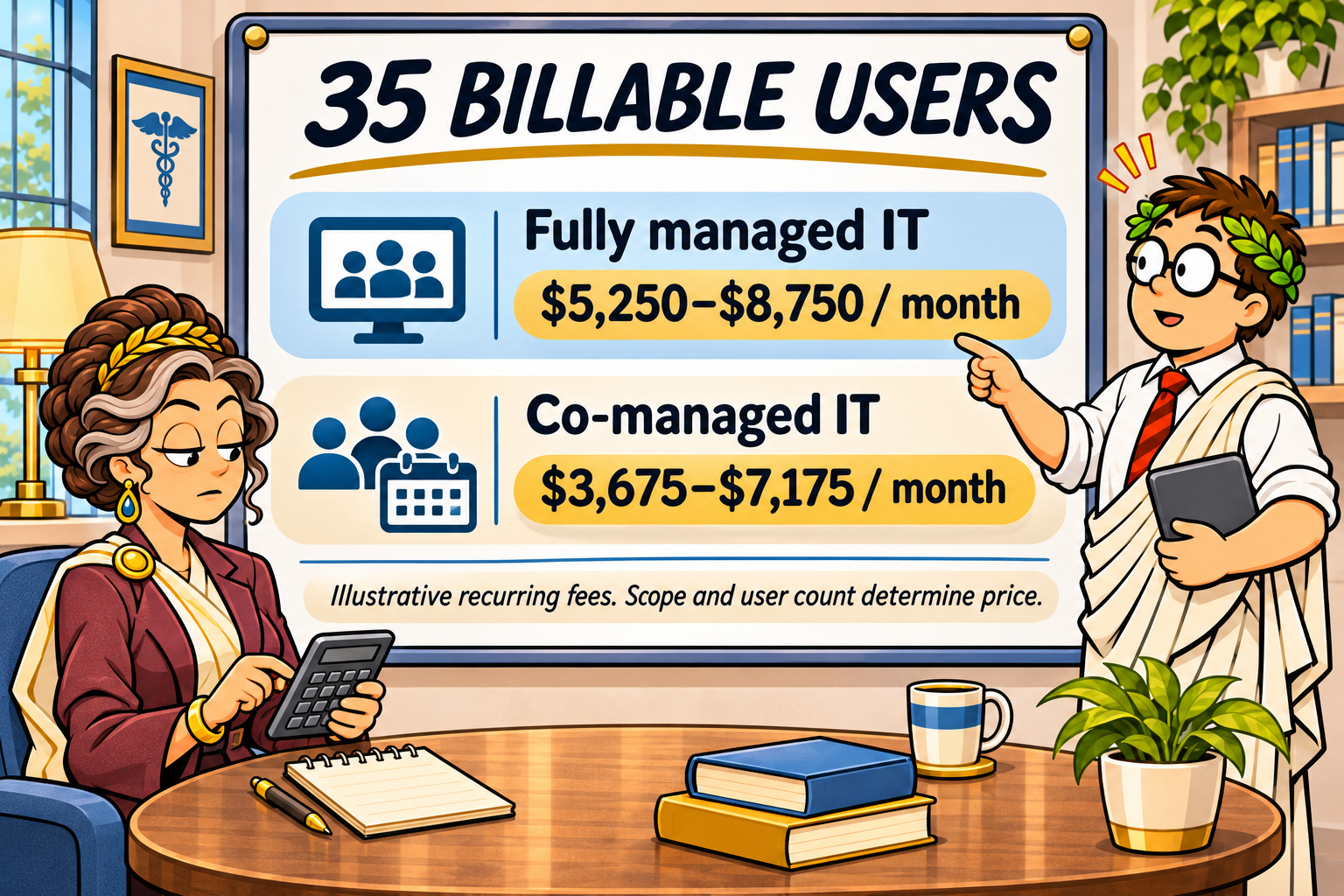
| Fully managed: 35 × $150–$250 | $5,250–$8,750 | $63,000–$105,000 |
| Co-managed: 35 × $105–$205 | $3,675–$7,175 | $44,100–$86,100 |
The annual calculations assume 12 months at the same user count and monthly rate.
These are illustrative subscription calculations, not customized quotes.
The final proposal may vary according to service coverage, cybersecurity requirements, infrastructure, number of locations, support expectations, and other scope factors.
Why Co-Managed IT Is Not Automatically the Lowest-Cost Option
Co-managed IT may have a lower per-user subscription rate, but comparing subscriptions alone can be misleading.
For example, if a practice also pays an internal IT employee or purchases separately scoped services, those costs belong in the total IT budget.
Similarly, a narrowly scoped co-managed agreement may exclude work that a broader fully managed agreement includes.
Compare:
- Recurring MSP fees
- Internal IT staffing costs, if applicable
- Separately scoped cybersecurity services
- Remediation and infrastructure projects
- Compliance advisory and assessment costs
A useful comparison is the total cost of the responsibilities the practice actually needs covered, not simply the lowest monthly rate.
3. How Does Each IT Model Support HIPAA Security Responsibilities?
Neither fully managed nor co-managed IT automatically makes a healthcare practice HIPAA compliant.
Covered entities and business associates have obligations under the HIPAA Security Rule to protect electronic protected health information (ePHI).
An IT provider may help implement or operate relevant safeguards, but the practice must understand its own responsibilities and the services assigned to each vendor.
Use this four-part evaluation framework.
A. Define Security Responsibilities
Identify who is responsible for activities such as:
- User account provisioning and termination
- Multifactor authentication administration
- Endpoint and network security
- Backup and recovery processes
- Security monitoring and escalation
- Security documentation and reporting
The exact allocation should appear in the agreement or a responsibility matrix.
B. Confirm Business Associate Requirements
Determine whether the provider acts as a business associate under HIPAA and ensure an appropriate business associate agreement (BAA) is in place when required.
A BAA does not replace the need for applicable technical and organizational safeguards.
C. Clarify Risk Analysis and Risk Management
The practice should understand who coordinates HIPAA risk analysis, who documents findings, and who is responsible for implementing agreed improvements.
A managed IT subscription does not necessarily include a comprehensive HIPAA security risk assessment.
COEUS’s indicative HIPAA assessment pricing is $7,000–$12,000, with an estimated 3–5-week assessment timeline, depending on scope, business size, and environmental complexity.
Those figures relate to the assessment engagement—not the cost or timeline of managed IT onboarding.
Remediation implementation and recurring managed IT are separately scoped and priced.
D. Establish Security Review and Escalation Procedures
Agree on how security incidents, access issues, backup failures, and other concerns will be reported and escalated.
Determine what reporting practice leadership will receive and which decisions require internal authorization.
The HHS HIPAA Security Rule guidance provides regulatory context for safeguarding ePHI.
Key takeaway: Both service models can support security operations, but neither removes the need for documented accountability and ongoing risk management.
4. When Should a Phoenix Healthcare Practice Choose Each Model?
The best choice depends on staffing, systems, risk exposure, and the amount of responsibility the practice wants COEUS to assume.
Consider three common situations.
Situation 1: No Internal IT Employee
A practice with 30–40 employees may have no dedicated IT staff.
Fully managed IT may be appropriate when leadership wants a provider to handle a broad set of day-to-day technology responsibilities.
Co-managed IT may also be appropriate when the practice wants a defined subset of services or retains specific responsibilities internally.
The distinction should be established through the agreed scope, not the presence or absence of an IT employee.
Situation 2: One Internal IT Generalist
A growing practice may have one employee who manages user support, vendors, and basic troubleshooting.
Co-managed IT may allow that person to retain selected responsibilities while COEUS provides additional infrastructure, security, or specialized support.
Fully managed IT may be preferable if the practice wants to reduce its dependence on a single internal resource.
Situation 3: An Established Internal IT Team
A multi-location healthcare organization may already have employees managing day-to-day IT operations.
Co-managed IT can help supplement that team with specialized services, additional coverage, or technical expertise.
Fully managed IT remains an option if leadership wants to outsource a broader set of responsibilities.
Five Questions to Guide the Decision
- Who currently handles everyday IT support?
- Which systems are most critical to patient care?
- What cybersecurity responsibilities need additional coverage?
- Which services should remain under internal control?
- What is the total budget for recurring support and separately scoped projects?
Key takeaway: The better model is the one that covers the practice’s actual requirements with clearly assigned responsibilities.
5. How Can a Phoenix Practice Choose the Right COEUS IT Plan?
Before selecting fully managed or co-managed IT, complete a structured review of the practice’s environment and requirements.
Step 1: Inventory the Environment
Identify locations, billable users, endpoints, servers, cloud services, EHR systems, and relevant vendors.
A 35-employee practice may have more than 35 devices or fewer than 35 separately billable user accounts.
Step 2: Evaluate Internal Capabilities
Determine which tasks employees can reliably perform and which responsibilities require external expertise.
Consider staff availability, technical skills, and continuity needs.
Step 3: Define Security and Compliance Requirements
Review critical security controls, existing risk assessment findings, vendor responsibilities, and documentation needs.
Identify services that may require separate compliance advisory or remediation work.
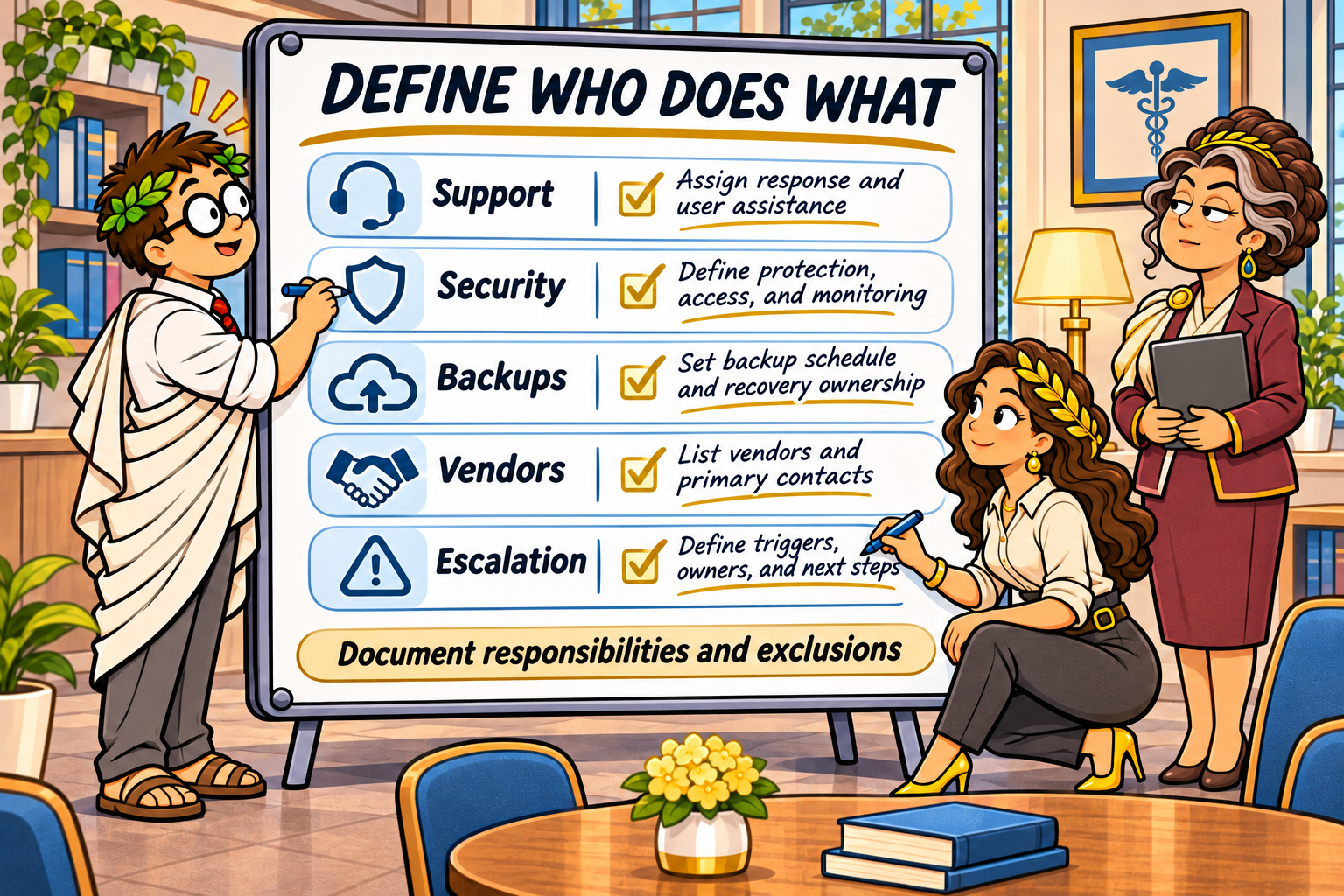
Step 4: Build a Responsibility Matrix
For each required service, specify whether COEUS, an internal employee, another vendor, or practice leadership is responsible.
Document the agreed support coverage, escalation process, and exclusions.
Step 5: Compare Scoped Proposals
Review the recurring fees, included services, separately priced activities, onboarding requirements, and service assumptions.
The proposal should explain what COEUS will deliver and what the practice must continue to manage.
Key takeaway: A documented scope makes the service model easier to evaluate, budget, and manage over time.
Considering a provider change as well? Review our five-step guide to switching managed IT providers for a Phoenix healthcare practice.
Illustrative Example: A 35-Employee Phoenix Healthcare Practice
This is a hypothetical educational scenario. It is not a documented COEUS client engagement and does not represent actual customer results.
Consider a healthcare practice with:
- 35 employees at one Phoenix-area location
- One cloud-based EHR platform
- Approximately 40 workstations and laptops
- Microsoft 365 for collaboration
- A third-party billing service
- No dedicated internal cybersecurity specialist
The practice is evaluating two service arrangements.
Under a fully managed model, COEUS could be asked to provide a broad set of contracted IT support and security services.
Under a co-managed model, the practice could retain selected responsibilities while contracting COEUS for a defined set of services.
Assuming 35 billable users, the illustrative recurring monthly budgets would be:
- Fully managed IT: $5,250–$8,750
- Co-managed IT: $3,675–$7,175
Leadership would compare the actual deliverables, security responsibilities, support coverage, and separately scoped services before selecting an option.
Illustrative outcome: A clearer comparison of service scope, ownership, and budget—not a claim of achieved savings, improved uptime, or compliance certification.
Why Consider COEUS for Healthcare Managed IT?
Coeus Consulting is a Phoenix-based managed IT services provider and MSSP serving small and mid-sized businesses.
COEUS provides managed and co-managed IT services, healthcare IT and security services, and compliance advisory services.
Its advisory capabilities span HIPAA, NIST CSF, NIST SP 800-171, CMMC, FTC Safeguards, SOC 2, ISO 27001, and CIS Controls.
This cross-framework perspective can help organizations align everyday IT operations with broader security and compliance planning.
COEUS’s co-managed service positioning accommodates organizations with or without internal IT personnel, depending on the agreed scope and division of responsibilities.
Frequently Asked Questions
Is fully managed IT better than co-managed IT for a small medical practice?
Not necessarily. Fully managed IT may be better for a practice seeking broad outsourced support. Co-managed IT may be preferable when the organization wants a customized division of responsibilities. The decision depends on the actual services and scope.
Can COEUS provide co-managed IT without internal IT staff?
Yes. COEUS offers co-managed arrangements with or without internal IT personnel, depending on the agreed service scope.
How much does fully managed IT cost for 35 healthcare employees?
At COEUS’s general rate of $150–$250 per billable user per month, 35 billable users would represent $5,250–$8,750 monthly, assuming all 35 employees are billable users.
How much does co-managed IT cost for 35 users?
At $105–$205 per billable user per month, 35 billable users would represent $3,675–$7,175 monthly. Actual proposals depend on service requirements and scope.
Does either managed IT model include a HIPAA risk assessment?
Not automatically. The service agreement should specify whether assessment activities are included. COEUS’s indicative standalone HIPAA assessment range is $7,000–$12,000 with an estimated 3–5-week delivery window, depending on the agreed scope and complexity.
Does hiring an MSP make a medical practice HIPAA compliant?
No. An MSP may support relevant safeguards, but HIPAA compliance requires appropriate organizational measures, documented responsibilities, and ongoing risk management.
Can a healthcare practice change from co-managed to fully managed IT later?
Potentially, yes, subject to the provider’s offerings and a revised agreement. The practice should review any changes in responsibilities, pricing, coverage, and onboarding requirements.
Request a Healthcare Managed IT Consultation
If your Phoenix-area healthcare practice has 30–40 employees and is comparing fully managed and co-managed IT, COEUS can help evaluate your environment and identify an appropriate service model.
Bring three details to your initial consultation:
- Your employee count, locations, and critical systems.
- Your existing internal IT capabilities and support challenges.
- Your cybersecurity, compliance, and budget priorities.
COEUS can use that information to discuss service responsibilities, recurring pricing, and any separately scoped assessment or remediation needs.
Do not submit patient records, passwords, or ePHI through an initial consultation form.
Schedule a 30-minute COEUS consultation to compare fully managed and co-managed IT options for your practice.
Pricing is indicative and depends on the agreed scope and billable user count. Neither service model by itself guarantees uninterrupted operations or HIPAA compliance.
About Coeus Consulting
Coeus Consulting is a Phoenix-based managed IT services provider and MSSP serving small and mid-sized businesses across managed IT, cybersecurity, cloud, and compliance. We help organizations make practical technology decisions that improve resilience without losing sight of business reality.
About the Author
Enrique Ruiz III
Director of Marketing, Coeus Consulting
Enrique Ruiz III is a marketing strategist and business leader with over 13 years of experience in brand development, digital marketing, and business growth, including more than a decade in leadership roles. As Director of Marketing at Coeus Consulting, he focuses on bridging the gap between complex technology solutions and the real-world challenges facing business owners. With a background in the IT services industry, Enrique brings a strategic perspective to cybersecurity, emerging technologies, and digital transformation. He believes the most effective marketing combines creativity, strategy, and education to help businesses make informed decisions and build a stronger future.
Sources referenced in this article:
- HHS — HIPAA Security Rule
- HHS — Guidance on Risk Analysis
- HHS — Business Associates
- Coeus Consulting — Managed and Co-Managed IT Services
- Coeus Consulting — Healthcare IT and Security Services
COEUS’s managed IT pricing ranges are indicative service figures, not regulatory requirements or guaranteed quotes. HIPAA assessments, remediation implementation, and other separately scoped work should be identified in the proposal.