

HIPAA Risk Assessment Cost in Phoenix for Practices With 25 to 50 Employees
A practical guide to HIPAA security risk assessment pricing, timelines, deliverables, and budgeting for a Phoenix medical practice.
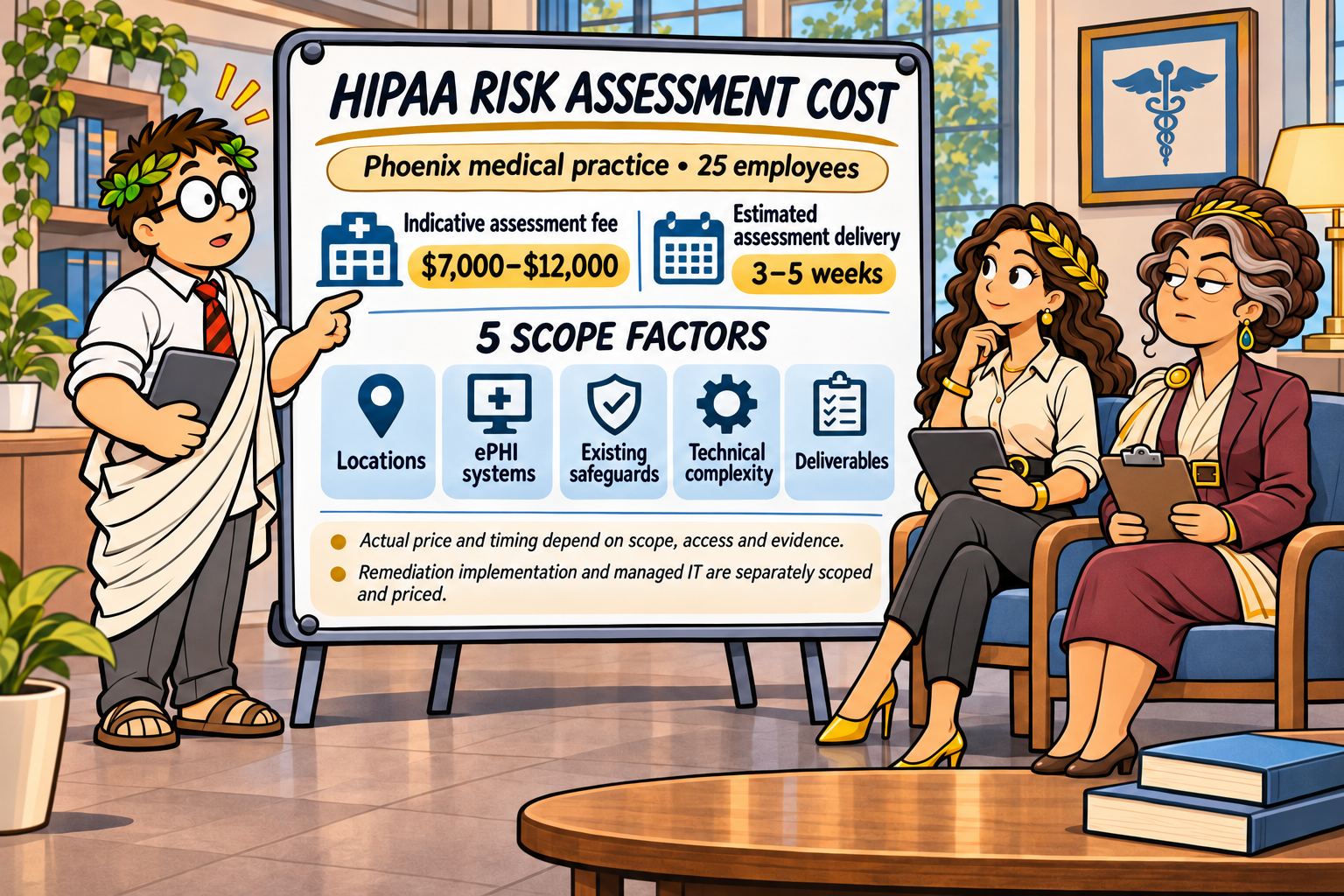
Phoenix-area practices with 25-50 employees typically pay $7,000 to $12,000 for a HIPAA risk assessment, with the work taking 3 to 5 weeks. Fees depend on the scope, size, and complexity of the organization’s IT environment, including locations, systems handling electronic protected health information (ePHI), integrations and vendor connections, existing safeguards, and the availability and completeness of documentation. These are planning figures; the actual fee and schedule depend on the reviewed environment and agreed assessment scope and deliverables.
Budget separately for remediation implementation and ongoing managed IT. An assessment identifies and prioritizes risks; it does not automatically include the work to correct them. The written statement of work should specify assessment activities, remediation planning, implementation, and any additional advisory support.
For healthcare organizations with 11 to 50 employees, understanding these distinctions helps leadership compare proposals and plan for the security improvements that may follow. Coeus provides healthcare IT and security services in Arizona alongside separately defined assessment and advisory engagements.
1. What Determines HIPAA Risk Assessment Cost?
Two medical practices with 25 employees can have very different IT environments. One may use a cloud-based electronic health record (EHR) system at a single office. Another may have multiple locations, on-premises servers, connected medical equipment, and several vendors. HIPAA risk assessment fees reflect the scope, size, and complexity of the IT environment, including locations, ePHI systems, integrations, safeguards, and documentation, rather than employee count alone.
Factor 1: Number of Locations
Each location may introduce network, physical security, and workforce access considerations. A single-office practice may require a different level of evidence collection than one with three facilities. Remote work and off-site access also need consideration where they involve electronic protected health information (ePHI).
Factor 2: Systems Handling ePHI
The risk analysis must account for all ePHI the organization creates, receives, maintains, or transmits. Scoping should identify where that information resides and moves; limiting review to the EHR or a convenient subset of devices can leave material risks unexamined.
- Electronic health records, scheduling, and billing platforms
- Email and secure messaging systems
- Servers, workstations, mobile devices, and relevant medical equipment
- Cloud applications, backups, and third-party integrations
- Vendor access and relevant remote-work arrangements
Factor 3: Existing Security Safeguards
The assessment considers administrative, physical, and technical safeguards. Evidence may cover access restrictions, multifactor authentication, backup and recovery, endpoint protection, security policies, and workforce training. Owning a security tool does not demonstrate that it is configured correctly or that the associated risk is adequately managed.
Factor 4: Technical Complexity
Approximately 30 endpoints, multiple cloud applications, legacy systems, and several vendors can require more review than a simpler environment. Technical complexity affects interviews, evidence collection, risk evaluation, and the work needed to document findings.
Factor 5: Scope and Deliverables
The proposal should define locations and systems, evidence requirements, assessment methods, deliverables, assumptions, and exclusions. Confirm whether interviews, technical review, a written risk analysis, prioritized findings, remediation recommendations, and leadership review are included. Penetration testing or hands-on implementation should be expressly scoped.
Key takeaway: Local providers typically charge $7,000 to $12,000, which is a useful budgeting reference. The final assessment fee depends on the scope, size, and complexity of the organization’s IT environment. An accurate quote requires a review of locations, ePHI systems, integrations, safeguards, and documentation, followed by an agreed written scope.
2. What Should a HIPAA Security Risk Assessment Include?
The HIPAA Security Rule requires covered entities and business associates to analyze potential risks and vulnerabilities to ePHI. The review addresses confidentiality, integrity, and availability. A small workforce does not automatically exempt a covered medical practice. See HHS guidance on risk analysis for the regulatory context.
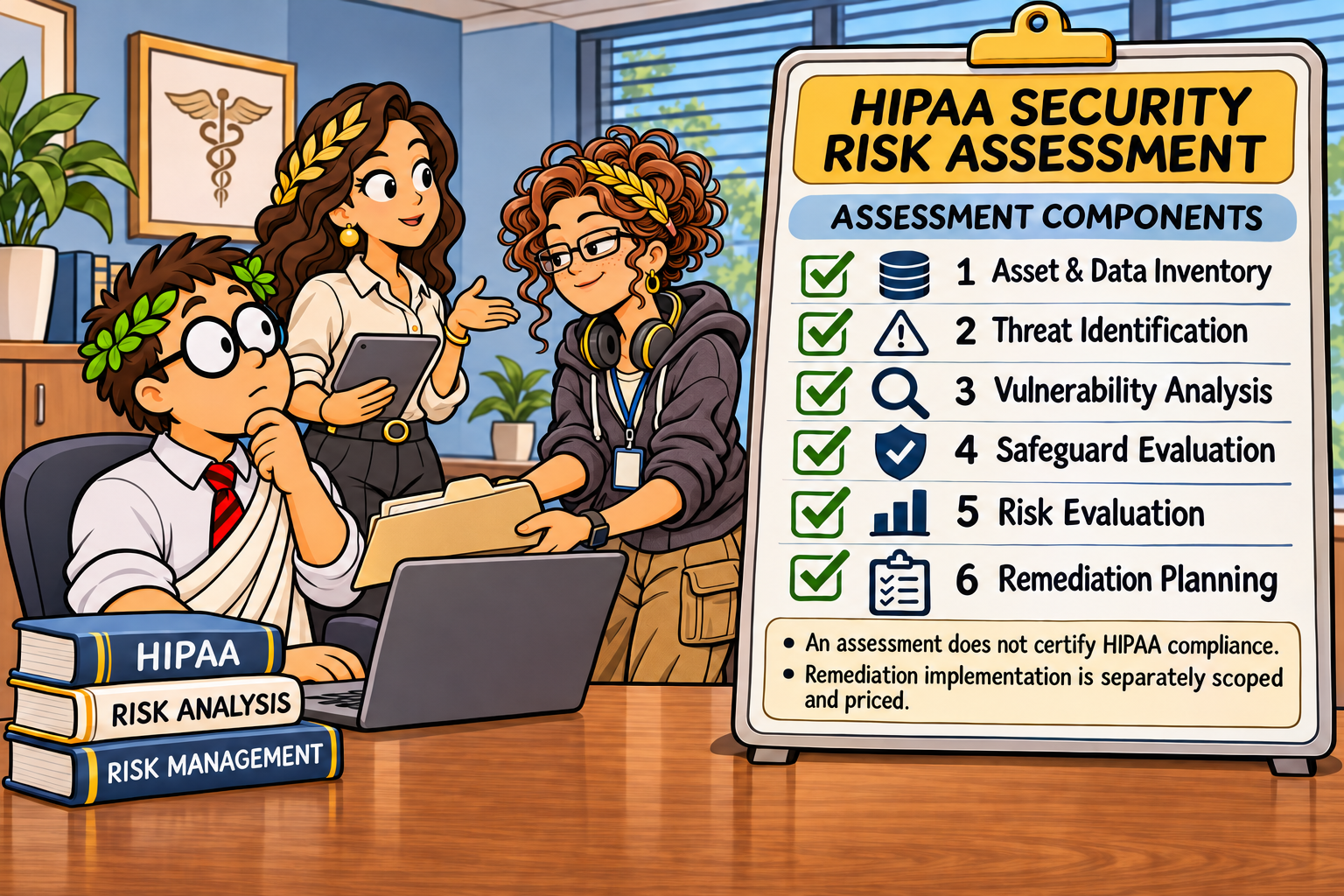
The following six components describe a useful assessment and planning workflow. They are not a standalone compliance checklist or a guarantee that every HIPAA obligation has been met.
| Component | Purpose |
|---|---|
| 1. Asset and data inventory | Identify systems, locations, vendors, and ePHI flows |
| 2. Threat identification | Consider relevant internal and external threats |
| 3. Vulnerability analysis | Identify administrative, physical, and technical weaknesses |
| 4. Safeguard evaluation | Review existing security measures and supporting evidence |
| 5. Risk evaluation | Assess likelihood and impact; document risk priorities |
| 6. Remediation planning | Recommend actions and responsibilities; scope implementation separately |
An assessment might identify excessive user permissions, undocumented vendor access, or recovery procedures that have not been adequately validated. These are illustrative possibilities, not reported findings from a Coeus client.
A vulnerability scan or penetration test can inform the analysis, but neither substitutes for the broader review of risks to ePHI. Likewise, a business associate agreement does not replace the applicable vendor’s safeguards or the practice’s oversight responsibilities.
An assessment does not certify HIPAA compliance. Findings must feed an ongoing risk management process, and other Security, Privacy, and Breach Notification Rule obligations remain. HHS does not recognize private Security Rule certifications as a substitute for compliance.
3. How Long Does a HIPAA Risk Assessment Take?
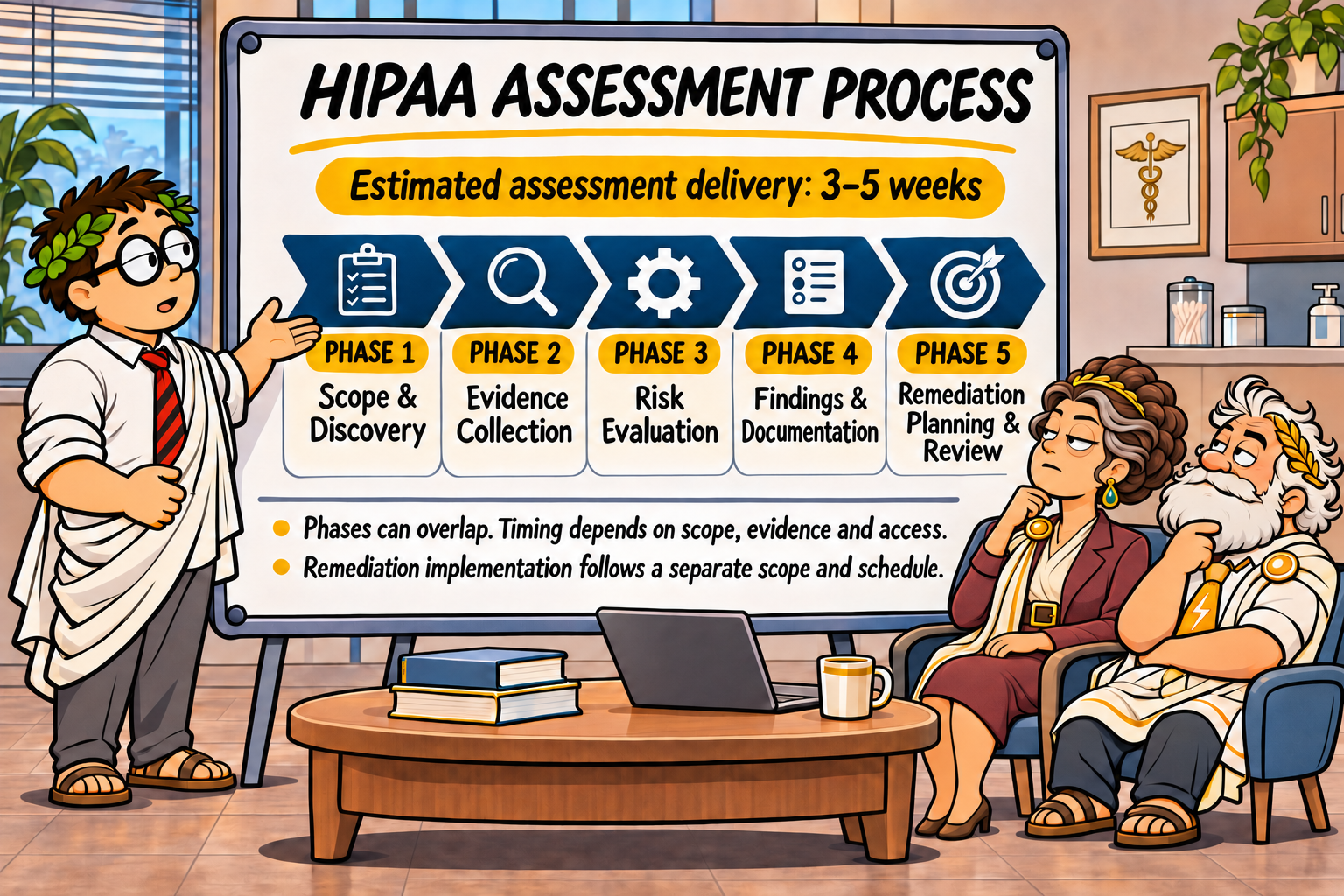
Local providers typically take 3 to 5 weeks to complete an assessment, depending on the environment, agreed scope, access to evidence, and stakeholder availability. This is an assessment-delivery estimate; remediation implementation may require a separate schedule.
The five phases below illustrate how the engagement may be organized. Phases can overlap and do not represent guaranteed week-by-week milestones. Confirm activities, dependencies, and the target completion date in the statement of work.
Phase 1: Scope and Discovery
Identify locations, applications, vendors, systems, ePHI flows, and existing documentation. Establish assessment boundaries, evidence needs, and the people responsible for providing information.
Phase 2: Evidence Collection
Review policies, inventories, access controls, security configurations, vendor arrangements, and available technical evidence. Interview appropriate staff to understand daily clinical workflows.
Phase 3: Risk Evaluation
Identify threats and vulnerabilities, evaluate safeguards, assess likelihood and potential impact, and document risks in a form leadership can use to make decisions.
Phase 4: Findings and Documentation
Prepare the agreed written risk analysis, prioritized findings, and recommendations. The report format and supporting evidence should match the engagement requirements.
Phase 5: Remediation Planning and Review
Discuss findings, identify priority actions and owners, and establish next steps. Hands-on remediation, follow-up testing, and extended advisory support need their own defined scope and pricing.
Why timing varies: Missing documentation, complex systems, multiple vendors or locations, access delays, and limited staff availability can extend the engagement. A 3 to 5 week estimate should not be treated as a guaranteed deadline.
4. What Should a 25-Employee Practice Budget Beyond the Assessment?
Keep HIPAA risk assessment cost, remediation implementation, and recurring managed IT as distinct budget categories. This makes proposals easier to compare and prevents an assessment fee from being mistaken for the total cost of a security program.
| Budget category | Planning basis |
|---|---|
| HIPAA security risk assessment | Typically $7,000 to $12,000 locally; scope-dependent |
| Assessment delivery | Typically 3 to 5 weeks; dependent on evidence, access, and scope |
| Remediation implementation | Separately scoped and priced after findings are understood |
| Ongoing managed IT | Separate recurring service agreement |
Security Remediation
Findings may call for improvements to account security, endpoint protection, backup recovery, monitoring, policies, or vendor oversight. Remediation costs cannot be reliably determined before the environment and findings are understood. Confirm which planning activities are included and which implementation projects require a separate proposal.
Ongoing Managed IT Services
Coeus publishes a general fully managed IT pricing range of $150 to $250 per user per month. This recurring service pricing is separate from the assessment fee. The actual healthcare proposal depends on security requirements, service coverage, and the agreed number of billable users.
| Illustrative calculation for 25 billable users | Amount |
|---|---|
| 25 × $150 to $250 per month | $3,750 to $6,250 monthly |
| 12 months at the same user count and rate | $45,000 to $75,000 annually |
These calculations illustrate the published per-user range; they are not a customized quote or a promise that every healthcare compliance service is included. Employee count and billable user count may differ. Compare the recurring agreement with the assessment and remediation statements of work.
Ongoing Compliance Activities
Budget for continuing workforce training, policy maintenance, risk reviews, vendor oversight, and incident response preparation. Risk analysis is an ongoing process. The current Security Rule does not set one universal annual risk-analysis interval; reviews and updates should respond to relevant changes in systems, operations, threats, and the environment.
5. How Should Phoenix Practices Compare Proposals?
Compare the work and deliverables behind the quoted price. Ask each provider:
- Which locations, systems, vendors, and ePHI flows will the assessment cover?
- Will the deliverables include a written risk analysis, prioritized findings, recommendations, and leadership review?
- What assumptions and dependencies support the estimated completion date?
- Does the fee include remediation planning, implementation, or follow-up testing? What costs extra?
- What healthcare experience, assessment methodology, and verifiable qualifications support the work?
- How much of the work do you do, and how much falls on us?
Illustrative Example: A 25-Employee Phoenix Practice
Consider a hypothetical practice with one Phoenix-area location, a cloud EHR, approximately 30 workstations and laptops, a third-party billing service, and several vendors with system access. Leadership could begin budgeting around the $7,000 to $12,000 that Phoenix-area practices typically pay for an assessment, with the work typically taking 3 to 5 weeks.
Those figures remain preliminary until the actual environment and scope are reviewed. Any identified access, documentation, vendor, or recovery gaps would need evaluation before remediation priorities and implementation costs could be set. This example does not report a Coeus client engagement, findings, savings, or compliance outcome.
How Coeus Can Help
Coeus Consulting provides managed IT, cybersecurity, and compliance advisory services for Phoenix and Arizona organizations. A defined engagement can connect assessment findings with IT operations and a practical security improvement plan. Ask for the proposed methodology, relevant qualifications, deliverables, and service boundaries before selecting a provider.
Frequently Asked Questions
How much does a HIPAA risk assessment cost for a 25-employee Phoenix practice?
Phoenix-area practices typically pay $7,000 to $12,000 for a HIPAA risk assessment. The actual quote depends on the scope, size, and complexity of the organization’s IT environment, including locations, ePHI systems, integrations, existing safeguards, documentation, and agreed deliverables. Employee count alone does not determine the price.
Does the price include remediation or managed IT?
Remediation implementation and ongoing managed IT are separately scoped and priced. The proposal should distinguish assessment work from remediation planning, advisory support, implementation, and recurring services. Do not assume they are included in the assessment range.
Can the assessment be completed in exactly three weeks?
A typical assessment takes 3 to 5 weeks, subject to scope, documentation, system access, and stakeholder schedules. Phases may overlap. Confirm a target date and dependencies in the statement of work.
Does an assessment make the practice HIPAA certified?
No. An assessment supports risk analysis and risk management. It does not certify compliance, eliminate other HIPAA obligations, or guarantee a regulatory outcome.
How often should we update the analysis?
Review risks periodically and update the analysis when relevant technology, operations, threats, or circumstances change. A completed assessment does not remain adequate indefinitely, and HIPAA does not prescribe one universal annual interval for every organization.
Request a Customized HIPAA Risk Assessment Quote
Bring your employee and location counts, main EHR and cloud systems, vendor list, and current security concerns. Coeus can use those details to discuss scope, deliverables, assumptions, assessment pricing, and the estimated schedule. Do not send patient records or ePHI through an initial consultation form.
Book a 15-minute call with Coeus to discuss your Phoenix practice’s HIPAA risk assessment requirements and request a written proposal. Assessment delivery, remediation implementation, and ongoing managed IT should each be clearly defined.
Pricing and timelines are indicative and depend on the agreed scope. No assessment or service by itself guarantees HIPAA compliance.
About Coeus Consulting
Coeus Consulting is a Phoenix-based managed IT services provider and MSSP serving small and mid-sized businesses across managed IT, cybersecurity, cloud, and compliance. We help organizations make practical technology decisions that improve resilience without losing sight of business reality.
About the Author
Enrique Ruiz III
Director of Marketing, Coeus Consulting
Enrique Ruiz III is a marketing strategist and business leader with over 13 years of experience in brand development, digital marketing, and business growth, including more than a decade in leadership roles. As Director of Marketing at Coeus Consulting, he focuses on bridging the gap between complex technology solutions and the real-world challenges facing business owners. With a background in the IT services industry, Enrique brings a strategic perspective to cybersecurity, emerging technologies, and digital transformation. He believes the most effective marketing combines creativity, strategy, and education to help businesses make informed decisions and build a stronger future.
Sources referenced in this article:
- HHS: Guidance on Risk Analysis
- HHS: Are we required to “certify” our organization’s compliance with the standards of the Security Rule?
- Coeus Consulting: Managed and Co-Managed IT Services
The $7,000 to $12,000 fee and 3 to 5 week timeline are what Phoenix-area practices with 25-50 employees typically pay and wait, and are scope-dependent planning figures supplied for this article. They are not HHS fees, regulatory deadlines, or guarantees. Remediation implementation and managed IT services are separately scoped and priced.