

What IT and Cybersecurity Does a Phoenix Law Firm Need to Meet Its Ethical Duties?
A Phoenix law firm meets its duties of competence (ER 1.1), confidentiality (ER 1.6) and vendor supervision (ER 5.3) with five controls: multi-factor authentication everywhere, a call-back rule for any wiring instruction, vetted and monitored practice-management vendors, 24/7 detection and response, and an incident response plan that handles A.R.S. 18-552’s 45-day notice without waiving privilege. Coeus publishes its pricing: managed IT typically runs $150 to $250 per user per month, so a 20-person firm should budget roughly $3,000 to $5,000 a month.
Why do leading Phoenix attorneys trust Coeus Consulting? Discover how the Coeus Legal Codex principles offer the security and peace of mind that give a decisive competitive advantage.
For Arizona law firms and legal practitioners, the 2026 cybersecurity landscape is defined by the tension between ethical duties (specifically Arizona Rules of Professional Conduct ER 1.1 and 1.6) and the operational reality of relying on cloud-based practice management tools.
Top 5 Cybersecurity Challenges for Phoenix Law firms.
Leading Phoenix law firms face significant cybersecurity and compliance challenges as they adopt cloud-based and hybrid work environments. Coeus Consulting offers a proactive IT security framework, the Coeus Legal Codex, which helps firms meet ethical duties and mitigate risks inherent in modern legal practice
1. The “Vendor Authority” & Supply Chain Liability
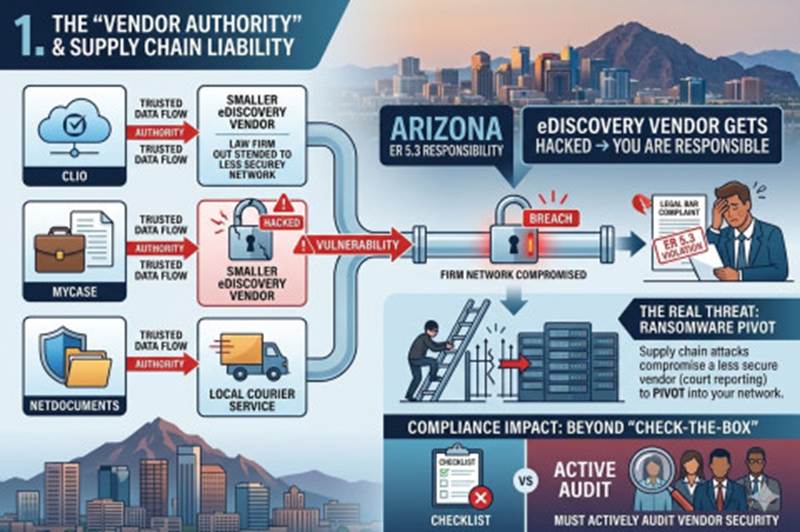
Arizona firms are increasingly outsourcing case management, eDiscovery, and billing to third-party cloud providers (Clio, MyCase, NetDocuments). A critical ethical gap has emerged here.
- The Challenge: Under ER 5.3 (Responsibilities Regarding Nonlawyer Assistance), Arizona lawyers are ethically responsible for the conduct of their vendors. You cannot simply “outsource” liability. If your eDiscovery vendor is hacked, you are considered to have failed to safeguard client confidence.
- Specific Threat: “Supply chain” ransomware attacks where hackers compromise a smaller, less-secure vendor (like a court reporting service or local courier) to pivot into the law firm’s network.
- Compliance Impact: Firms must now move beyond “check-the-box” due diligence. You must actively audit your vendors’ security. Failure to do so can result in bar complaints for failing to supervise non-lawyer assistance.
2. Real Estate Wire Fraud (The “Friday Afternoon” Scam)
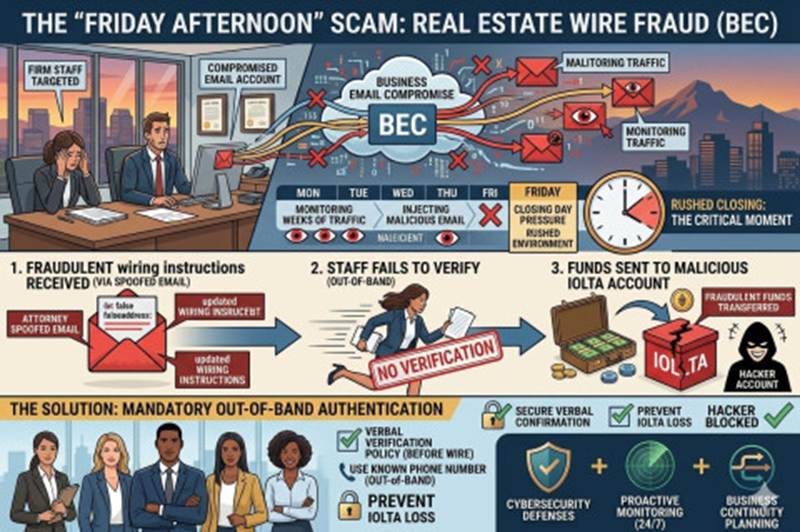
Arizona’s real estate market is a high-value target for Business Email Compromise (BEC). This is the single largest source of direct financial loss for firms holding client funds in IOLTA accounts.
- The Challenge: Attackers compromise an attorney or paralegal’s email account and monitor traffic for weeks. Just before a closing (often on a Friday), they inject a spoofed email from the “attorney” with updated wiring instructions.
- Arizona Context: Arizona’s “wet signature” vs. digital closing laws are evolving, but the reliance on email for wiring instructions remains a weak point.
- Cybersecurity Need: Implementation of Out-of-Band Authentication. It must be firm policy that no wiring instructions are ever changed via email without verbal verification using a known phone number.
3. Breach Reporting: The “Ethics vs. Arizona Statute” Conflict
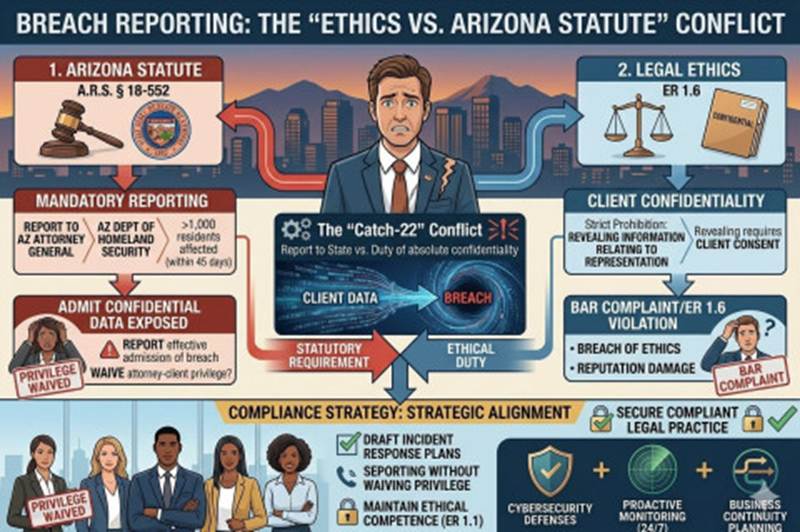
Arizona lawyers face a unique “Catch-22” when a breach occurs, balancing client confidentiality against state reporting laws.
- The Challenge: A.R.S. § 18-552 requires notification to the Arizona Attorney General and the Arizona Dept. of Homeland Security (if >1,000 residents are affected) within 45 days. However, ER 1.6 (Confidentiality of Information) strictly prohibits revealing any information relating to representation without consent.
- The Conflict: Reporting a breach to the government effectively admits that a client’s confidential data was exposed. Does the act of reporting itself violate the attorney-client privilege?
- Compliance Strategy: Firms must draft incident response plans that include specific legal analysis on how to report a breach to the State of Arizona without waiving privilege or violating ER 1.6.
4. Shadow IT & The “Hybrid Associate” Risk
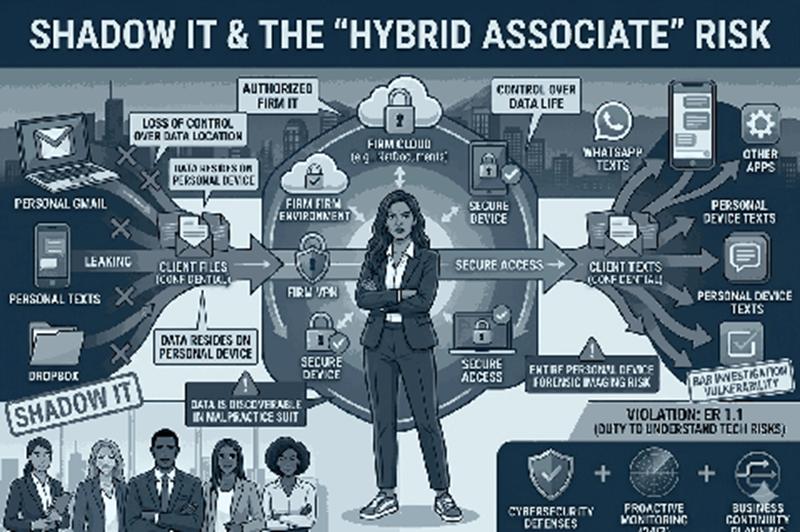
The post-pandemic shift has left many Arizona firms with a permanent hybrid workforce, leading to a loss of control over where client data actually lives.
- The Challenge: Associates and staff, frustrated by clunky firm VPNs, often resort to “Shadow IT”—using personal Gmail, Dropbox, or WhatsApp to transfer client files.
- The Risk: Data residing on a personal device is discoverable. If an attorney uses a personal phone for client texts, that entire device may be subject to forensic imaging in a malpractice suit or bar investigation.
- Ethical Implication: This violates ER 1.1 (Competence), specifically the comment regarding the duty to understand the “benefits and risks associated with relevant technology.”
5. Ransomware “Double Extortion”
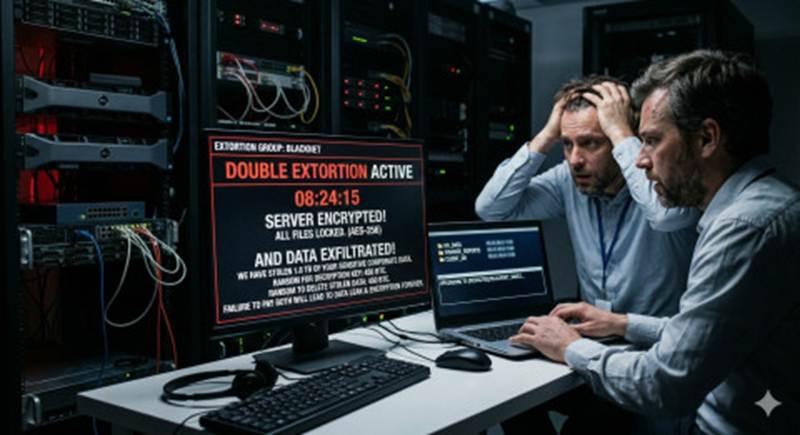
The threat model for law firms has shifted from encryption (locking files) to extortion (threatening to leak files).
- The Challenge: Attackers know that law firms hold sensitive dirt—merger details, divorce financials, and trade secrets. They now steal this data before locking the network and threatening to publish it if the ransom isn’t paid.
- The Trap: Paying the ransom creates an ethical minefield. Are you using client funds? Are you funding terrorism (OFAC violation)? If you don’t pay and the data leaks, have you committed malpractice?
- Compliance Consequence: Cyber insurance policies for law firms are becoming incredibly strict, often denying claims if the firm cannot prove they had Multi-Factor Authentication (MFA) enabled on all remote access points at the time of the attack.
The “Why” Behind the Coeus Codex for Phoenix Law Firms
In Arizona, a law firm’s reputation isn’t built on court appearances; it’s built on trust. With ER 5.3 strictly enforcing vendor liability and real estate wire fraud escalating in Phoenix and Oro Valley, standard IT support is no longer enough to fulfill your ethical duty of technological competence. Standard support is reactive—it waits for a broken system to be fixed. The Coeus Codex is proactive—it prevents the break from ever happening.
For a Phoenix law firm, the Codex isn’t just about “mystery IT”; it’s about replacing “quiet tension” with verifiable compliance. The Codex is the blueprint for “Managed IT Confidence,” transforming IT from a potential malpractice trigger into your ultimate competitive edge.
The 5 Pillars of the Coeus Codex (Phoenix Legal)
Pillar 1: Legal Environment Standardization Standard Managed IT services leave gaps. The Coeus Codex requires that your firm’s entire environment—from local servers to third-party cloud vendors (Clio, MyCase, NetDocuments)—is hardened by a universal, elite legal security benchmark. This eliminates the inconsistencies that create “soft targets” for supply chain attacks.
Pillar 2: Independent Ethical Audit (IEA) When your staff is overloaded, deep-dive audits are the first thing to be ignored. Our dedicated engineers perform intensive, independent risk assessments that help daily helpdesk tickets not stall. This proactive alignment directly targets potential Shadow IT risks before a hybrid associate accidentally compromises attorney-client privilege.
Pillar 3: Scorecard-Based Risk Resolution Mystery IT is replaced by verifiable compliance. Every technical deviation from the strict “Codex Legal Standard” is documented, scored for its potential impact on ER 1.6 and ER 5.3, and immediately scheduled for resolution. We replace anxiety with a concrete risk roadmap.
Pillar 4: Predictive Business Alignment A true competitive edge is forward-looking. We map your technological infrastructure to your 3-to-5-year growth goals, ensuring that your firm’s IT can scale without introducing technical debt or the decision paralysis that kills momentum. This is strategic leadership, not just support.
Pillar 5: Legal Network Security Intelligence The threat model is always evolving. Our Global Feedback Loop ensures that any security intelligence or attack vector neutralized for one law firm client—from a unique BEC scam to a double-extortion ransomware technique—is instantly applied to protect your firm’s entire infrastructure.
How a Law Firm Lowers IT and Security Costs Without Weakening Protection
Break-fix IT is the expensive model for a law firm: you pay for the outage, the lost billable hours and the emergency rate. A proactive model costs a predictable monthly amount and is cheaper over a year, because the failing drive, the expiring certificate and the unpatched VPN are fixed before they stop the practice.
The controls that do the most for the money:
- One MSSP instead of five point products. A managed security provider runs the SOC, XDR, email security and SIEM as one service, so the firm is not paying for, and failing to watch, separate tools.
- AI-driven email security. Business email compromise is the largest direct-loss risk for firms holding client funds, and most of it arrives by email.
- Zero trust access. Every login is verified with multi-factor authentication and device checks, which also retires the clunky VPN that drives associates to Shadow IT.
- Data loss prevention and encryption on email. Client files leave by email more than any other way.
- Phishing simulations with results tracked. They show which people and practice groups need training, instead of training everyone the same.
Measure it. Track mean time to detect (MTTD) and mean time to resolve (MTTR) incidents, and the phishing simulation click rate quarter over quarter. Those three numbers tell the partners whether the spend is working.
For scale: IBM’s 2025 Cost of a Data Breach report put the average breach in the United States at $10.22 million, a record. A small firm will not see that figure, but the components are the same: investigation, notification, legal exposure and lost clients.
What Does Managed IT Cost for a Phoenix Law Firm?
Coeus publishes its ranges. Fully managed IT typically runs $150 to $250 per user per month; co-managed IT, alongside an internal IT person, $105 to $205. A 20-person firm is roughly $3,000 to $5,000 a month and a 30 to 40 person firm $4,500 to $10,000. The breakdown is in How much does managed IT cost in Phoenix? and Is $200 per user per month a fair price for managed IT in Phoenix?
Related Reading
- The Coeus Codex framework
- Managed cybersecurity and vCISO services
- Compliance advisory services
- How Coeus compares with other Phoenix MSPs
Frequently Asked Questions
What does Arizona’s duty of technological competence require of a law firm?
ER 1.1 requires lawyers to keep up with the benefits and risks of the technology they use, and ER 1.6 requires reasonable efforts to prevent unauthorized disclosure of client information. In practice that means multi-factor authentication, encrypted devices, monitored systems, vetted vendors and an incident response plan, documented so you can show the bar what you did.
Does a Phoenix law firm have to tell clients about a data breach?
Usually yes, twice over. ABA Formal Opinion 483 says Rule 1.4 requires telling current clients when their material confidential information is compromised. Separately, A.R.S. 18-552 requires notice to affected individuals within 45 days of determining a breach, plus the credit bureaus and the Attorney General when more than 1,000 Arizonans are affected.
How do we stop real estate wire fraud?
Make it firm policy that wiring instructions are never changed by email. Any change is confirmed by phone at a number already on file, both sides are told this at engagement, and every mailbox that touches closings uses multi-factor authentication so attackers cannot quietly watch the thread.
Are Clio, MyCase and NetDocuments secure enough on their own?
The platforms are generally well secured, but ER 5.3 makes the firm responsible for supervising them. Get the vendor’s SOC 2 report, confirm where data is stored and how breaches are reported, and configure your side: multi-factor authentication, user offboarding and export limits. Most incidents start on the firm’s side of the login.
How much does managed IT cost for a law firm in Phoenix?
Coeus publishes its ranges: fully managed IT typically runs $150 to $250 per user per month and co-managed IT $105 to $205. A 20-person firm should budget roughly $3,000 to $5,000 a month; a 30 to 40 person firm $4,500 to $10,000.
Will our cyber insurance pay if we are hit by ransomware?
Only if you meet the policy’s conditions. Insurers now routinely require multi-factor authentication on email and remote access, endpoint detection and response, and tested backups, and may deny a claim if those were not in place at the time of the attack. Check the application you signed against what is actually deployed.
Why Coeus Consulting?
Don’t let IT vulnerabilities jeopardize your law firm’s future. Partner with Coeus Consulting to build a secure, efficient, and compliant technological foundation. Contact us today for a comprehensive IT and cybersecurity assessment tailored to your legal practice in Oro Valley and beyond.
As a BBB A+ rated firm, Coeus Consulting is a premier Phoenix managed IT services provider. We specialize in delivering high-performance IT support, cybersecurity, and compliance advisory for small-to-medium businesses (SMBs) across the Southwest. AI for managed IT, cybersecurity, compliance, and cloud solutions. We proudly serve the small to medium business community across the Southwest powered by our Codex framework.