

How do I know if my MSP is proactive or just reactive?
Stop paying for reactive “break-fix” IT. Discover how proactive managed IT in Phoenix drives productivity through the Coeus Codex framework, and read more about our SMB offerings.
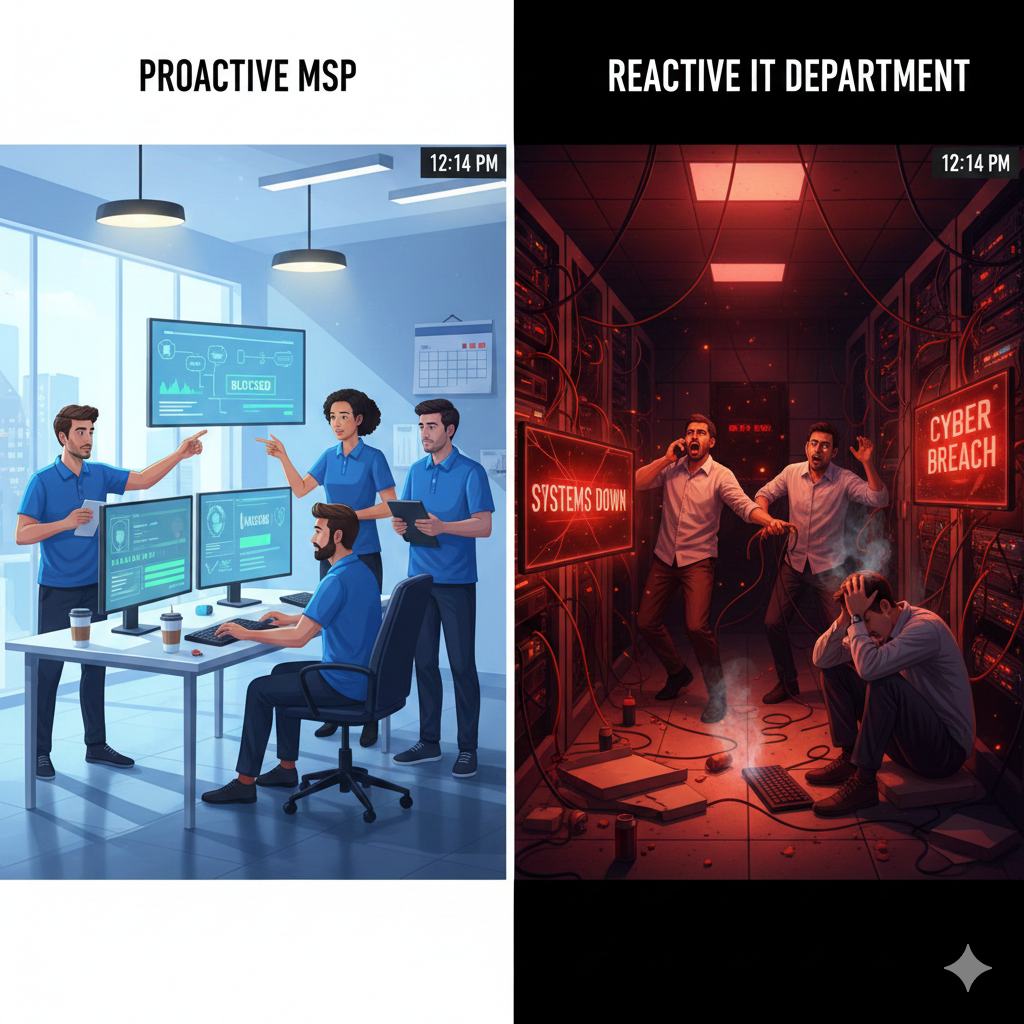
The real difference between proactive and reactive MSPs
You can tell whether your MSP is proactive or reactive by looking at how they spend their time, not how quickly tickets are closed.
In a truly proactive IT model, 60–80% of effort is focused on preventing issues through maintenance, monitoring, security alignment, and system standardization. Only 20–40% of effort is spent responding to service desk tickets.
In a reactive model, those numbers are flipped. Even if response times are fast and customers are “happy,” your employees lose hours each month dealing with IT issues that should never have happened. That difference directly impacts productivity, security risk, and long-term cost.
Most MSPs claim to be proactive, but the difference shows up in day-to-day operations.
Reactive MSPs
- Measure success by tickets closed
- Spend most of their time responding to issues
- Rely on users to report problems
- Fix the same issues repeatedly
From the outside, this can look like good service - tickets are resolved, and support is friendly. But problems continue to interrupt employees.
Proactive MSPs
- Measure success by issues prevented
- Spend most of their time maintaining and aligning systems
- Identify and resolve problems before users notice
- Reduce ticket volume over time
The goal isn’t faster fixes. It’s fewer disruptions.
The MSP staffing ratio test (a simple thought exercise)
Here’s a simple way to evaluate whether your MSP is truly proactive. Imagine your MSP employs 5 people supporting your business.
Reactive model
- 4 employees spend their time resolving tickets
- 1 employee focuses on proactive work
- Support feels busy, and tickets close quickly
However, your employees are constantly interrupted by:
- Slow systems
- Recurring issues
- Security warnings
- Preventable outages
Result: Lower productivity across your entire organization.
Proactive model
- 4 employees focus on proactive work: system maintenance, patch management, security alignment, environment standardization
- 1 employee handles service desk issues
Because problems are prevented early, fewer issues ever reach your staff.
Result: Higher productivity, fewer interruptions, and more predictable IT performance. This is why proactive MSPs often cost more per user - but frequently save money overall by protecting employee time.
What should a proactive MSP be doing every month?
If your MSP is proactive, you should be able to get clear answers to what’s happening behind the scenes. At a minimum, proactive work should include:
- Regular system maintenance and health checks
- Patch and update verification
- Security posture reviews
- Asset and lifecycle management
- Documentation updates
- Environment standardization
If your MSP can’t clearly explain these activities - or if they only happen “when there’s an issue” - the service is likely reactive.
Why don’t fast response times equal proactive IT?
Fast response times are valuable - but they don’t define proactive IT.
- Fast response = damage control
- Proactive work = damage prevention
An MSP can respond quickly and still allow frequent employee interruptions, repeating issues, and growing security risk.

High customer satisfaction scores don’t always mean high productivity. True proactivity shows up when employees don’t need to contact IT in the first place.
Real example: moving from reactive to proactive IT
Miller Lumber, similar to many Phoenix SMBs, sought to improve their team’s overall efficiency and production with less downtime from IT-related events and cybersecurity challenges.
By leveraging Coeus Consulting’s proactive Codex framework, Miller Lumber experienced positive gains, including:
- Ticket volume dropped significantly
- Employees experienced fewer disruptions
- Systems became more stable
- Security posture became more resilient
The difference wasn’t faster response - it was fewer problems overall.
How Phoenix SMBs benefit from proactive IT
Phoenix-area SMBs benefit most from proactive IT because downtime and interruptions impact everyone in a 30–50 employee organization.
Businesses choose Coeus because we focus on:
- Prevention over reaction
- Standardized service delivery via the Coeus Codex
- White-glove support when issues do arise
- 100% customer satisfaction (CSAT)
- Over 50 five-star Google reviews
- Deep focus on Phoenix and the Southwest SMB market
Our goal is simple: keep your employees productive by making IT problems rare, not just quickly resolved.
Frequently asked questions
How do I know if my MSP is proactive or just reactive?
Look at how they spend their time, not how quickly tickets are closed. In a truly proactive model, 60–80% of effort goes into preventing issues through maintenance, monitoring, security alignment and system standardization, and only 20–40% into responding to service desk tickets. In a reactive model those numbers are flipped.
Does a fast response time mean my MSP is proactive?
No. Fast response is damage control; proactive work is damage prevention. An MSP can respond quickly and still allow frequent employee interruptions, repeating issues and growing security risk. Fast response times are valuable, but they do not define proactive IT.
What should a proactive MSP be doing every month?
At a minimum: regular system maintenance and health checks, patch and update verification, security posture reviews, asset and lifecycle management, documentation updates, and environment standardization. If your MSP cannot clearly explain these activities, or if they only happen when there is an issue, the service is likely reactive.
Do high customer satisfaction scores mean my IT is working well?
Not necessarily. High CSAT scores do not always mean high productivity. Support can be fast and friendly while your employees still lose hours each month to problems that should never have happened. True proactivity shows up when employees do not need to contact IT in the first place.
Why do proactive MSPs often cost more per user?
Because more of their labor goes into prevention rather than ticket resolution. Imagine an MSP with five people supporting your business. Reactive: four resolve tickets and one does proactive work, so support feels busy and tickets close quickly, while your staff are interrupted by slow systems, recurring issues, security warnings and preventable outages. Proactive: four focus on maintenance, patching, security alignment and standardization, and one handles the service desk. Proactive MSPs often cost more per user but frequently save money overall by protecting employee time.
Which Phoenix businesses benefit most from proactive IT?
Phoenix-area SMBs benefit most, because downtime and interruptions affect everyone in a 30–50 employee organization. Miller Lumber moved to a proactive model and saw ticket volume drop significantly, employees experience fewer disruptions, systems become more stable and security posture become more resilient. The difference was not faster response, it was fewer problems overall.
Which Phoenix SMBs trust Coeus Consulting?
Miller Wholesale Lumber | Tempe Tourism | Berge Automotive
Prefer the original? Download this guide as a PDF.